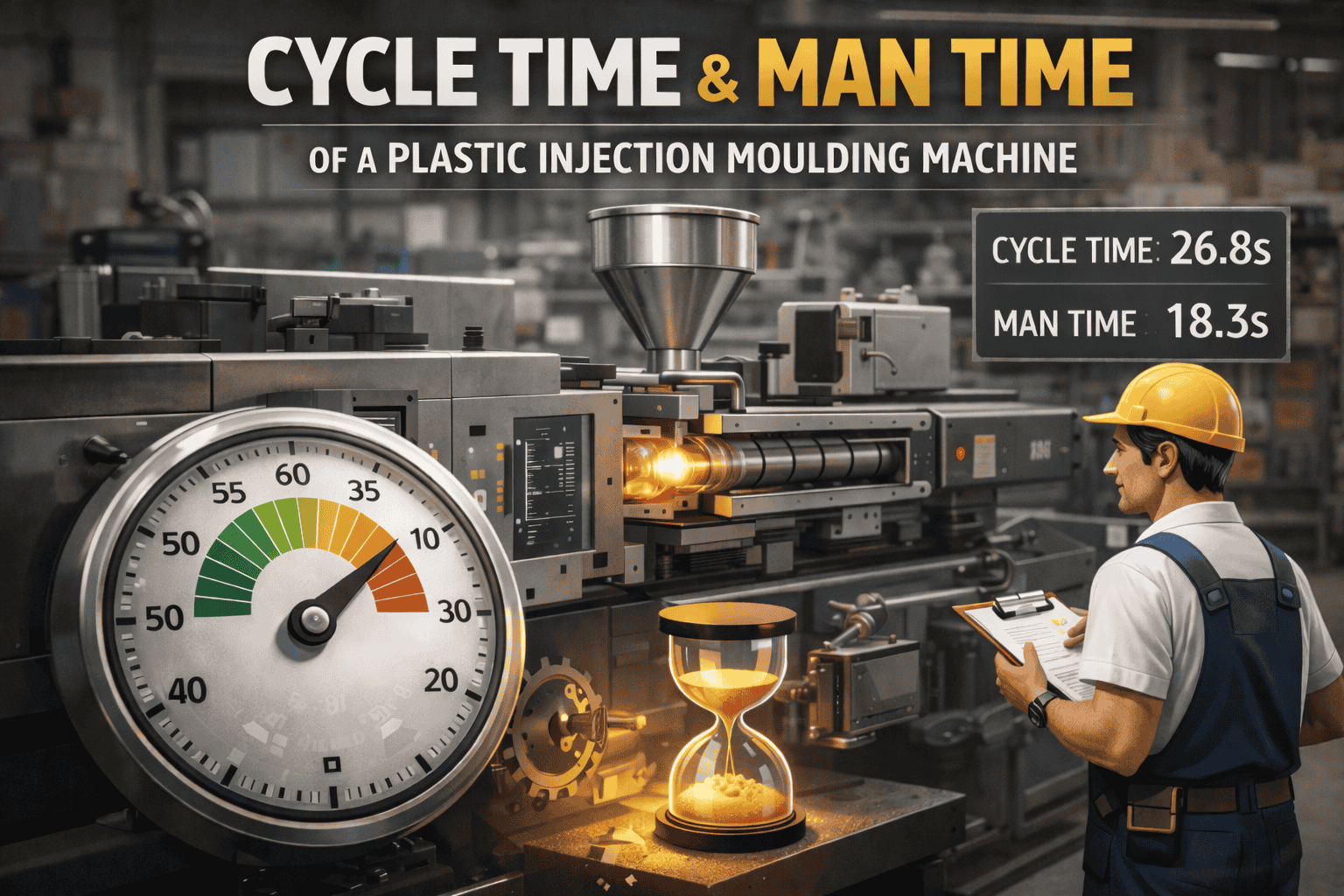
Cycle Time and Man Time of a Plastic Injection Moulding Machine

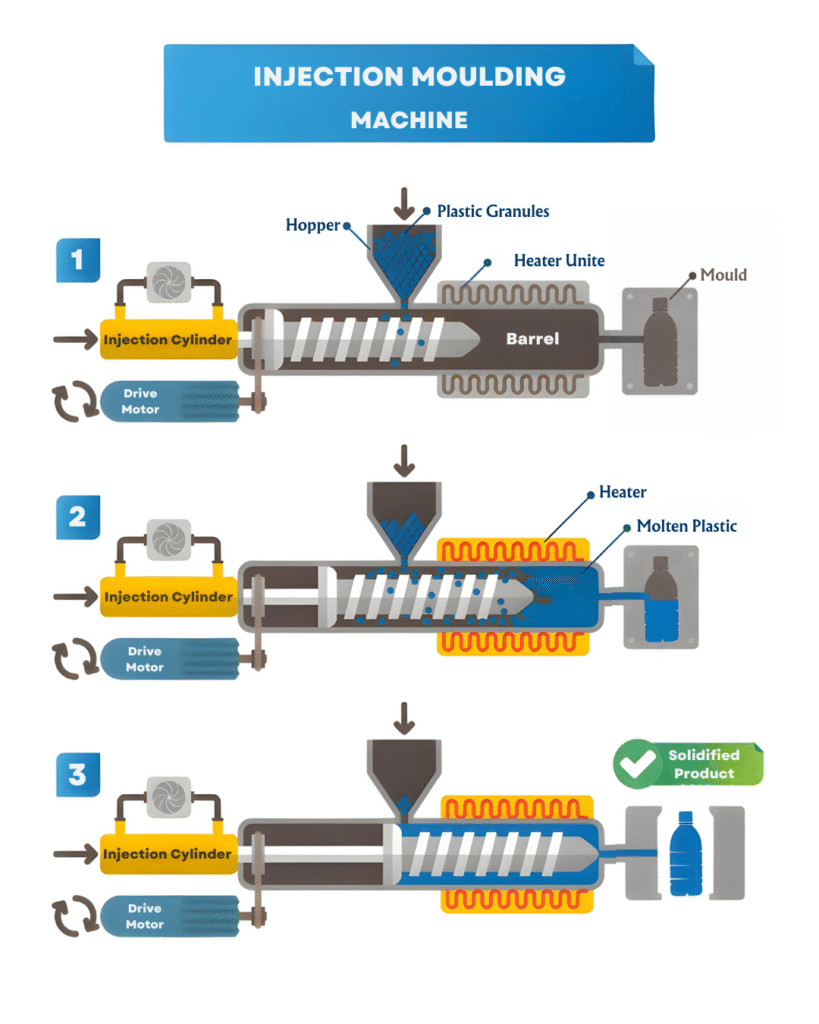
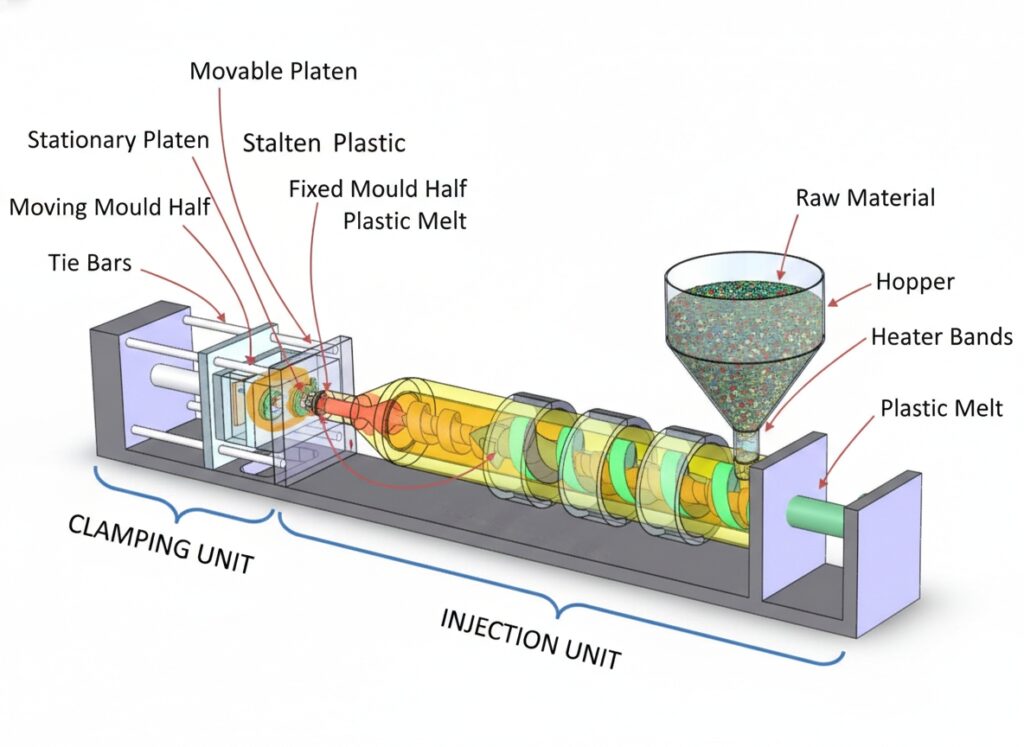
Introduction
In the plastic injection moulding industry, efficiency, productivity, and cost control are critical for success. Two key parameters that directly influence these factors are cycle time and man time.
Understanding and optimizing cycle time and man time helps manufacturers increase output, reduce cost per part, and improve delivery performance, making them essential metrics in modern injection moulding operations.
What Is Cycle Time in Plastic Injection Moulding?
Cycle time is the total time required to produce one complete moulded part, measured from the start of one cycle to the start of the next.
Typical Injection Moulding Cycle Stages
- Mould closing
- Injection (filling)
- Holding / packing
- Cooling
- Mould opening
- Part ejection
Cycle Time Formula
Cycle Time = Injection Time + Holding Time + Cooling Time + Mould Open & Close Time + Ejection Time
Example
If one part is produced every 30 seconds, then:
- Cycle time = 30 seconds
- Output = 120 parts per hour (single cavity)
Why Cycle Time Is Important
- 🚀 Higher production output
- 💰 Lower manufacturing cost per part
- ⚙️ Better machine utilization
- 📦 Faster order fulfillment
Even a 2–3 second reduction in cycle time can result in significant savings in high-volume production.
What Is Man Time in Plastic Injection Moulding?
Man time refers to the human labor time required to support the injection moulding process.
This includes:
- Material loading
- Manual part removal
- Trimming and finishing
- Quality inspection
- Packing
- Machine setup and adjustments
Man Time Formula
Man Time = Total labor time required per part or batch
Example
If an operator takes 2 minutes to pack 10 parts:
- Man time per part = 12 seconds
Difference Between Cycle Time and Man Time
| Aspect | Cycle Time | Man Time |
|---|---|---|
| Type | Machine-based | Human-based |
| Controlled by | Machine, mould, material | Operator efficiency |
| Measured in | Seconds | Seconds / Minutes |
| Impacts | Output & machine efficiency | Labor cost |
👉 Cycle time focuses on machine performance, while man time focuses on labor efficiency.
Relationship Between Cycle Time and Man Time
- In fully automatic machines, man time is minimal
- In semi-automatic machines, man time can equal or exceed cycle time
- Poor balance causes:
- Machine waiting for operators
- Increased idle time
- Reduced productivity
Best practice:
👉 Man time should always be less than or equal to cycle time
Average Cycle Time of a Plastic Injection Mould
One of the most common questions in injection moulding is:
“What is the average cycle time of a mould?”
There is no fixed cycle time for all moulds. It varies depending on part design, material, mould design, and process conditions. However, industry experience provides reliable average ranges.
Typical Average Cycle Time Ranges
| Part Type | Average Cycle Time |
|---|---|
| Thin-wall parts (caps, containers) | 5–10 seconds |
| Small precision components | 10–20 seconds |
| Medium-size plastic parts | 20–40 seconds |
| Thick or reinforced parts | 40–90 seconds |
| Large automotive / industrial parts | 60–180 seconds |
👉 Industry average for most standard moulds:
20–30 seconds per cycle
Why Cooling Time Dominates Cycle Time
- Cooling time accounts for 60–80% of total cycle time
- Injection and holding times are relatively short
- Poor cooling design leads to long cycles and higher cost
This makes cooling system design the most critical factor in cycle time optimization.
Typical Cycle Time Example
- Injection + holding: 4 seconds
- Cooling time: 18 seconds
- Mould open, eject & close: 6 seconds
Total cycle time = 28 seconds
➡️ Approx. 128 parts/hour (single cavity)
What Is Considered a Good Cycle Time?
- Under 15 seconds: Excellent (thin-wall moulds)
- 20–30 seconds: Ideal for most production moulds
- Above 40 seconds: Needs optimization
- Above 60 seconds: High cost unless unavoidable
How to Reduce Cycle Time
- Optimize cooling channel design
- Improve mould design and venting
- Use correct material melt temperature
- Maintain machines properly
- Use automation such as robotic part removal
How to Reduce Man Time
- Operator training and standard procedures
- Ergonomic workstation layout
- Automation for removal and packing
- Batch inspection instead of individual inspection
Why These Metrics Matter to Customers
Optimized cycle time and man time result in:
- Competitive pricing
- Consistent quality
- Faster delivery
- Reliable high-volume production
For manufacturers, this means higher margins and better scalability.
Conclusion
Cycle time and man time are two pillars of efficiency in plastic injection moulding. Understanding their relationship and optimizing both helps manufacturers reduce costs, increase productivity, and stay competitive.
By improving mould design, cooling efficiency, and labor utilization, injection moulding operations can achieve maximum output with minimum waste.